
A New Incense Bibliography Part 1: History & Art
Short Reviews of Favorite and WTF Books About Incense

I’ve been a non-fiction junkie since I was a teenager. Whether trashy or classy memoirs, recipe books, travelogues, history tomes or pop science, I love a true story or clear how-to. Naturally, as soon as I fell into the subject of incense, I sought out everything I could read about it. My first sources were a short video, a web page, and the bibliographies in two books by my OG incense guru, Daddy Carl (Carl Neal). Most were excellent, but I hankered for more. Thus I searched the internet and my local public library, using Neal’s bibliographies as a jumping off point to explore not only incense, but human olfaction, perfumery, art criticism, and even fiction. (While I do enjoy fiction, I’m picky about it. I can stand badly written nonfiction, but crappy fiction makes me irrationally angry.)
As great as Daddy Carl’s bibliographies are, they’re over 5 years old now. Join me as I bring some attention to a few books (and some very strange random…items) either more recently published or randomly found during my searches. Some are great, most are informative, and a few are just too WTF not to mention. Be sure to check the link in each title, where I’ve linked to a (non-Amazon) place to purchase the book or a free source to read it online.

Ships, Furs, and Sandalwood: A Yankee Trader in Hawai’i, 1823-1825 by Charles H. Hammatt
Through the cool lens of Charles Hammatt, a Boston merchant, this journal captures the rise and fall of King Liholiho (Kamehameha II) due to the influence of Euro-American culture, trade, missionary zeal, and economics. Hammatt is in Hawaii to trade ships and other goods for Hawaiian’ ‘iliahi/ sandalwood, which the monarchy had been exploiting for quick cash for the past 20+ years. Hammatt’s journal details the ‘iliahi bubble bursting in addition to the state of the monarchy at that time. Hammatt was a haole of the early 1800s, and so viewed native Hawaiians none too charitably. King Liholiho comes off as a roaring drunk, though his ali’i ministers make up for his irresponsibility by being very shrewd wheeler-dealers (much to Hammatt’s chagrin). So much is said between the lines of this seemingly simple record of business deals and ships coming and going...the wealth and squandering of it by elites, the transformation of an indigenous society by capitalism, and the slow extirpation of species due to the whims of market. It’s short, to the point, and a little terrifying.


The Books of Natural Perfumer, Mandy Aftel
There’s a natural overlap between perfumery and incense, and Mandy Aftel’s beautiful books are friendly, enthusiastic guides into a huge and intimidating world (for me at least). Filled with simple recipes, history, poetry, and deeply researched knowledge, all three of these books sparkle. Essence and Alchemy is inspiration for a million natural perfumers and contains a recipe for ambergris hot chocolate I’m dying to try. Fragrant focuses on five scented ingredients—cinnamon, mint, frankincense, ambergris, and jasmine—and the culture, science, and lore behind what makes each of them so redolent. And, for those who can’t visit the gorgeous Aftel Archive in person, The Museum of Scent is the next best thing. This lovely coffee table book contains pictures of the Archive’s items, art objects, and lovingly preserved ancient books, as well as tidbits of lore about nearly a hundred perfume and incense ingredients. It even comes with a scratch ‘n sniff bookmark! I am in awe of Aftel’s artistry as a perfumer and writer both.
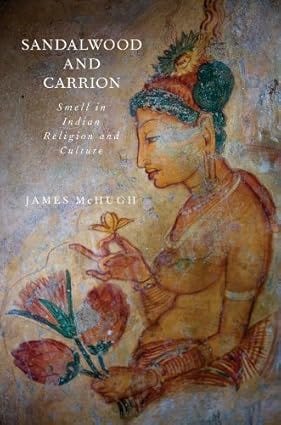
Sandalwood and Carrion: Smell in Indian Religion and Culture, James McHugh
This was an academic, yet highly engaging study of ancient Sanskrit texts as they deal with aromas, incense, flowers, and smells. It was interesting to review three religious worldviews--Hinduism, Jainism, and Buddhism--through their early texts’ ordering of the scent world. I especially liked the exploration of sandalwood as an object and phenomenon. The chapter “Moon Juice and Uproar” details some deeply metatextual / bitextual wordplay within ancient incense recipes that hint at an incredibly sophisticated culture of scent and literature. Take this example of (translated) poetry, which works as a riddle, a moral aphorism, and a recipe all at once:
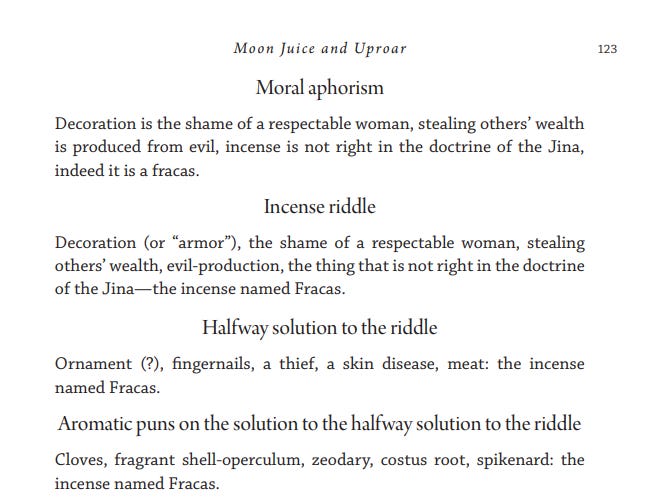
France gets way too much credit as the birthplace of perfume...India is obviously IT.
Holy Smoke: Censers Across Cultures, edited by Beate Fricke
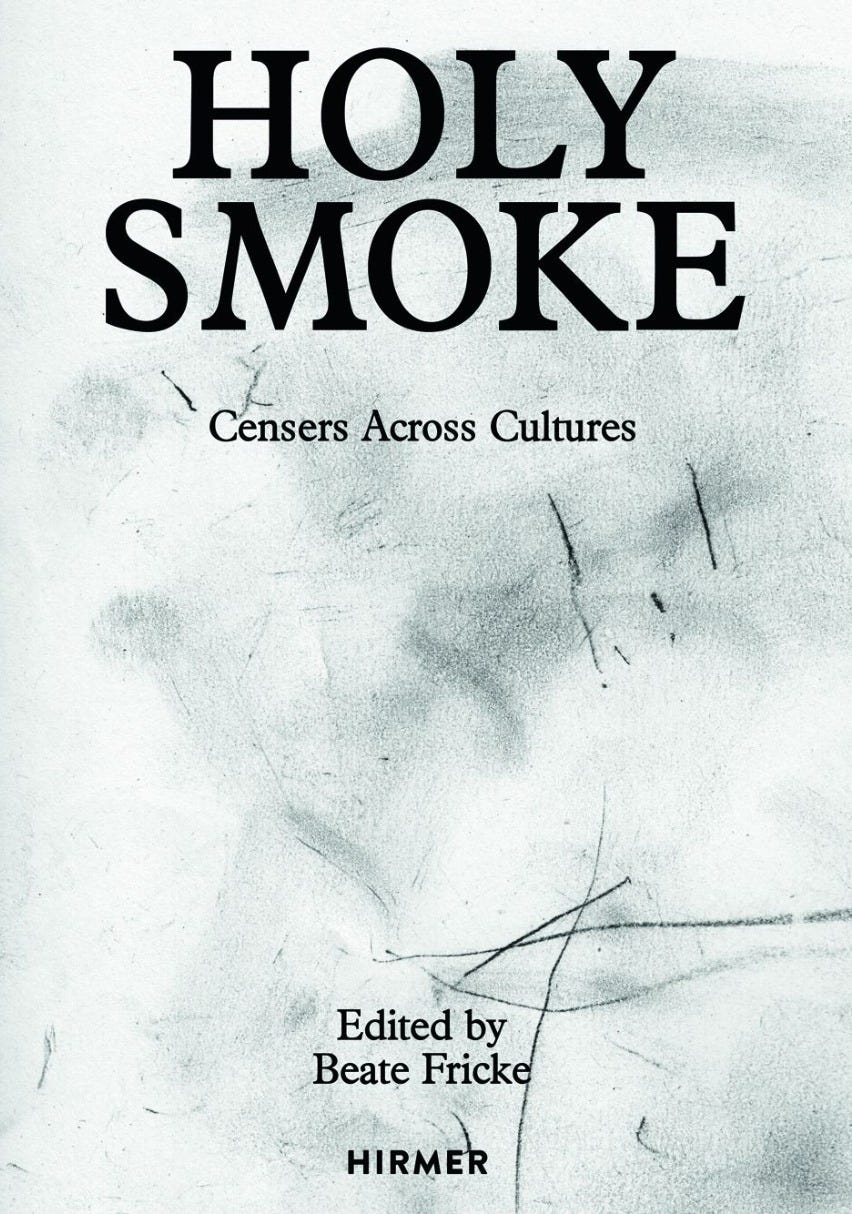
Censers—the containers that hold burning incense—are hugely interesting and varied art forms unto themselves. Holy Smoke is a luxuriously huge coffee table book featuring sumptuous pictures of censers and censer-themed art from around the world. The essays inside were largely academic art history and were very interesting and varied: ancient Chinese artwork featuring incense smoke as arcane pointers to everlasting life; the “smells and bells” controversies between Catholic and early Protestant Christian churches; art historical explorations of Arabian and Mesoamerican censers, and more. As a special added, embodied touch, the book came wrapped in an inky paper (like newsprint) that left soot-like marks on my hands--just like a censer would, of course. This book is a perfect melding of information and design, a true prize among my incense book collection.
These look great, thank you!
Great choice of books!!!